
What Is Structured Cabling & Why It Matters
What Is Structured Cabling & Why It Matters: The Backbone of Modern Networks
In today's fast-paced digital world, a robust and reliable network is no longer a luxury—it's a fundamental necessity for businesses of all sizes. From seamless communication to efficient data transfer, everything hinges on your network infrastructure. But what exactly underpins this critical foundation? The answer often lies in structured cabling.
You might not see it, but structured cabling is the unsung hero that keeps your business connected, productive, and future-ready. Let's dive into what structured cabling is, its key components, and why it's absolutely crucial for your organisation.
What is Structured Cabling?
At its core, structured cabling is a standardised system of cables and connectivity hardware that forms a comprehensive telecommunications infrastructure. Instead of a chaotic tangle of wires specific to individual applications, structured cabling designs a unified, organised, and scalable cabling system that can support multiple hardware uses and be easily adapted for future needs.
Think of it like the nervous system of your building. Just as your nerves systematically connect different parts of your body to your brain, structured cabling systematically connects all your devices—computers, phones, servers, access points—to your network, and ultimately, to the outside world.
Key Components of a Structured Cabling System
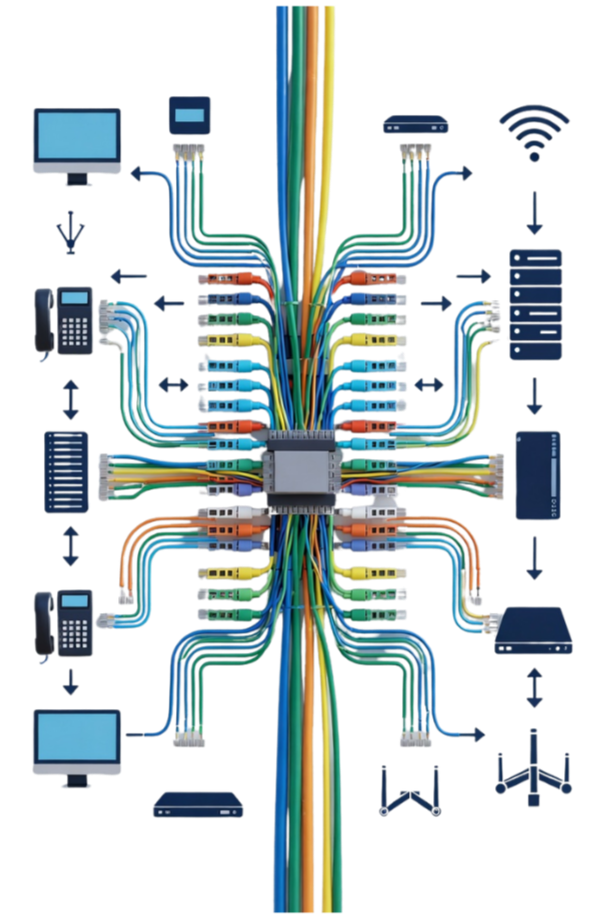
A typical structured cabling system is built around six primary subsystems, each playing a vital role:
Main Distribution Area: This is the central point of your network, housing core switches, routers, and cross-connects that link your entire network together.
Intermediate Distribution Area: Often found in larger campuses or multi-floor buildings, Intermediate Distribution Areas provide a hierarchical connection between the Main Distribution Area and Horizontal Distribution Areas.
Horizontal Distribution Area: Located in telecommunications rooms, Horizontal Distribution Areas connect horizontal cabling to the active equipment.
Horizontal Cabling: These are the cables that run from the telecommunications room (Horizontal Distribution Area) to individual work area outlets, providing connections to user devices.
Work Area Outlets: The wall plates or jacks where users plug in their devices (computers, IP phones, etc.).
Backbone Cabling: This cabling interconnects the main distribution area, intermediate distribution areas, and horizontal distribution areas, often using high-capacity fibre optic cables for long distances and high bandwidth.
Why Structured Cabling Matters for Your Business
Investing in a well-designed and properly installed structured cabling system offers a multitude of benefits:
Reliability & Uptime: A standardised and organised system significantly reduces the risk of network errors, downtime, and troubleshooting headaches. When everything is clearly labeled and installed correctly, identifying and resolving issues becomes much faster and easier, ensuring continuous operations.
Scalability & Future-Proofing: Structured cabling is designed with growth in mind. It's easy to add new devices, users, or even entire departments without needing a complete overhaul of your network infrastructure. This adaptability future-proofs your investment against evolving technology and business needs.
Performance & Speed: High-quality cables and components, combined with proper installation, ensure optimal data transmission speeds and network performance. This is crucial for applications requiring high bandwidth, such as video conferencing, cloud computing, and large file transfers.
Simplified Troubleshooting: With clear labeling and documentation, pinpointing the source of a network problem becomes a straightforward process, minimising disruption and saving valuable IT time.
Cost-Effectiveness: While the initial investment might seem significant, structured cabling saves money in the long run by reducing maintenance costs, improving efficiency, and preventing costly downtime.
Aesthetics & Organisation: A neat and organised cable management system looks professional and makes working in your server rooms and offices much more pleasant and safer.
The Bottom Line
Structured cabling is more than just wires and connectors; it's the invisible yet indispensable foundation upon which your entire business network operates. It provides the reliability, performance, and flexibility necessary to support current operations and adapt to future technological advancements.
If your business relies on a stable, fast, and scalable network—which almost all do today—then understanding and investing in structured cabling isn't just a good idea; it's an essential strategy for long-term success.
Need Professional Structured Cabling?
Understanding structured cabling is one thing, designing and installing it correctly is another. A well planned cabling system is the foundation of a reliable, scalable network, and poor installation can lead to performance issues, downtime and costly rework.
At Discover Networks, we design and install structured cabling systems that support modern business demands — from high-speed data and VoIP to Wi-Fi, CCTV and future expansion. Our team works with you to ensure your infrastructure is built properly from day one, using industry best practices and certified testing.
If you’re planning a new installation, upgrade or simply want expert advice, we’re here to help.