
Fibre Optic Installation Best Practices
The Backbone of Speed: Essential Best Practices for Fibre Optic Installation
In the world of telecommunications, fibre optics are the gold standard. They offer bandwidth and speeds that copper simply cannot match. However, glass is unforgiving. Unlike copper, which can often survive a bit of rough handling, fibre optic cables require precision, cleanliness, and strict adherence to physical limits.
A poor installation doesn't just look messy; it results in high insertion loss, high return loss, and intermittent network failures that are a nightmare to troubleshoot.
Whether you are a seasoned technician or new to the field, these best practices are the non-negotiable rules for a high-performance fibre network.
1. Safety First: Respect the Glass (and the Light)
Before touching a tool, remember that fibre installation carries unique risks.
Laser Safety: Never look directly into a fibre end. Active fibres carry invisible infrared light that can permanently damage your retina. Always assume a fibre is "live" until tested.
Shard Management: When cleaving fibre, the off-cuts are sharp, invisible shards of glass. If they penetrate your skin or are ingested (via food/drink nearby), they can cause serious injury. Always use a dedicated sharps container and work on a black mat where shards are visible.

The number one cause of fibre network failure is contamination. A dust particle that is invisible to the human eye can completely block the core of a single-mode fibre (which is only ~9 microns wide).
Clean Everything: Brand new patch cords out of the bag are not guaranteed to be clean.
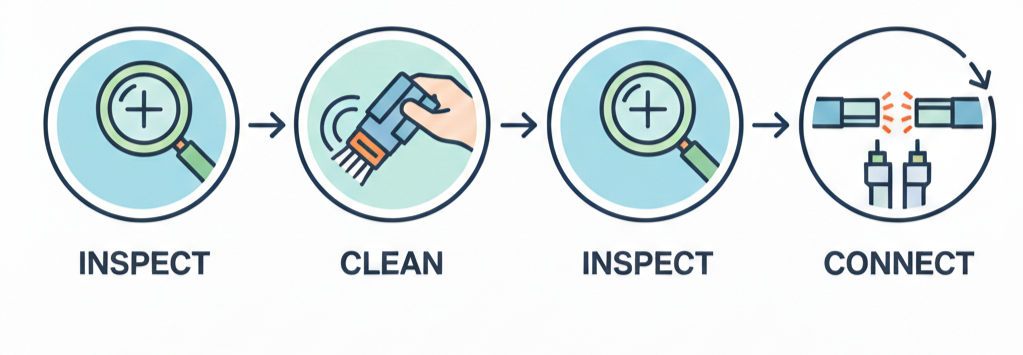
The Process: Inspect -> Clean -> Inspect -> Connect.
Tools: Use a proper click-cleaner or lint-free wipes with 99% isopropyl alcohol. Never touch the end-face with your finger; the oils from your skin are catastrophic to the signal.
2. The Golden Rule: Inspect Before You Connect
3. Cable Handling: Don't Stress the Glass
Fibre is strong in tension but weak in shear and bend.
Respect the Bend Radius
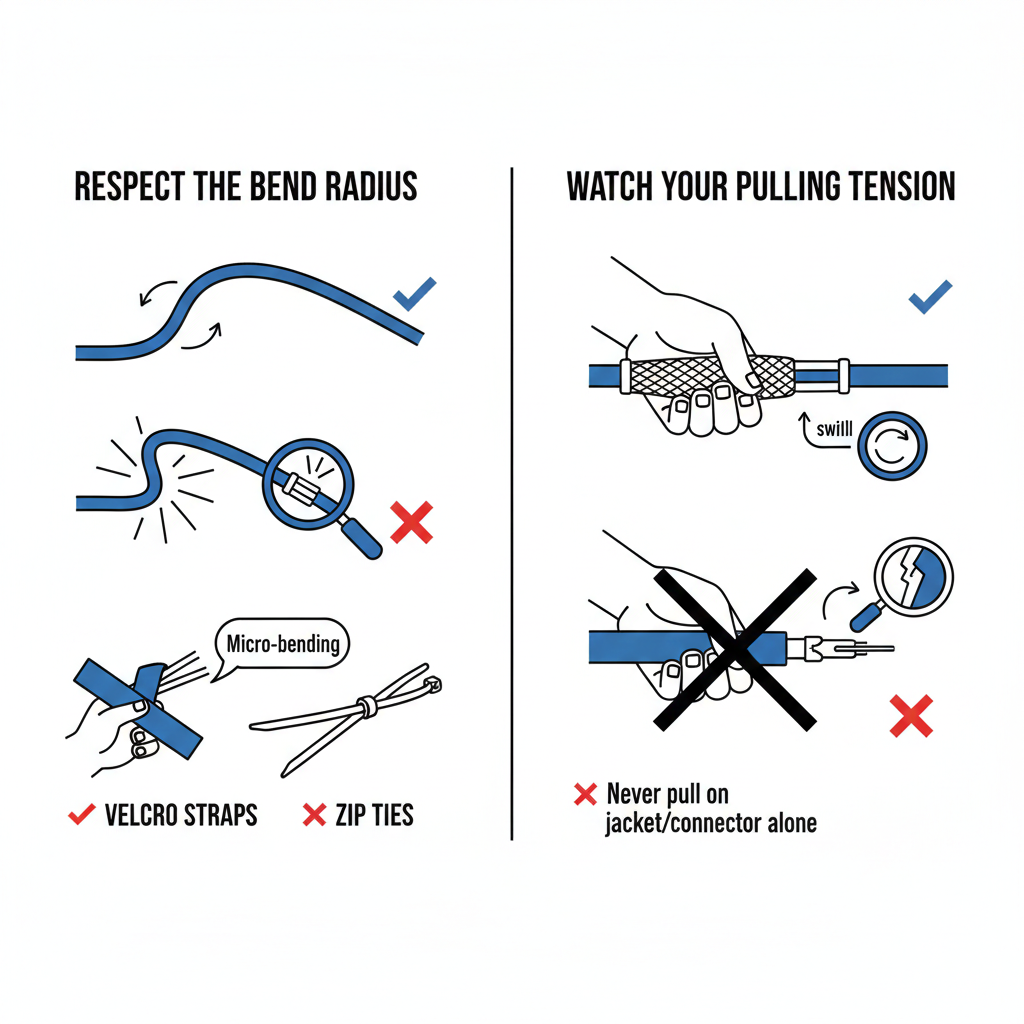
Every cable has a minimum bend radius—usually 10x the cable diameter for static bends and 20x for dynamic (during pulling) bends.
Macro-bending: Visible kinks that cause light to leak out of the cladding.
Micro-bending: Minute distortions caused by tight zip ties or compression.
Best Practice: Use velcro straps instead of plastic zip ties. Zip ties can easily over tighten and crush the glass micro-structure.
Watch Your Pulling Tension
Never pull a fibre cable by the connector or the jacket alone.
Use the Strength Member: Always attach your pulling grip to the aramid yarn (Kevlar) or the central strength member.
Use a Swivel: When pulling long runs, use a breakaway swivel to prevent the cable from twisting. If a fibre cable twists, it can fracture the glass cores inside.
4. Route Planning and Management
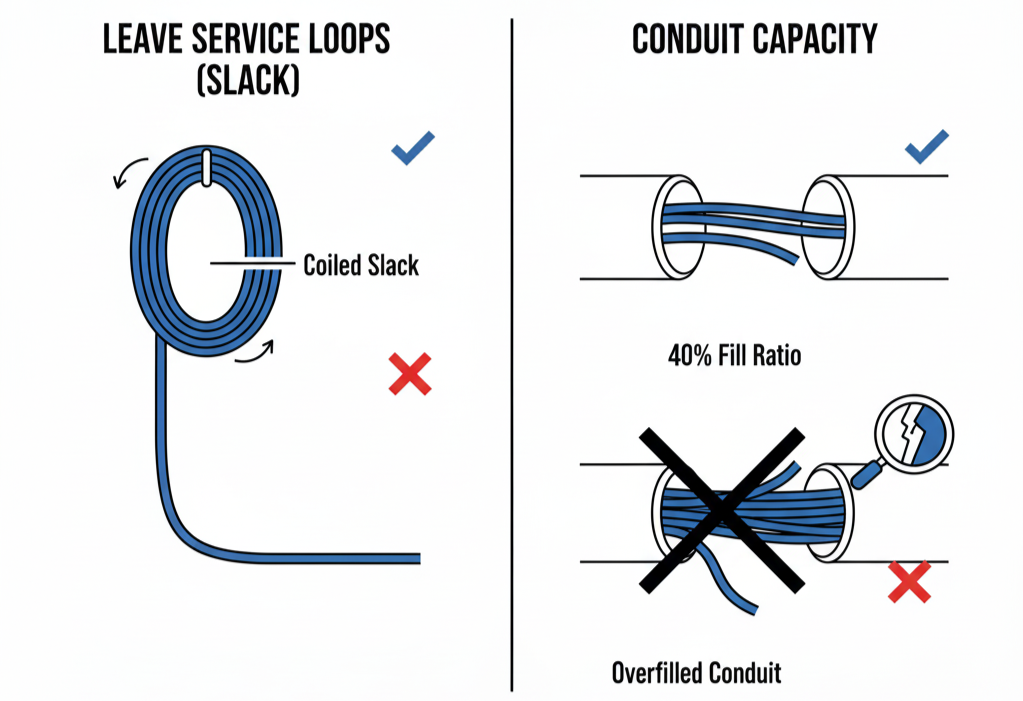
Leave Service Loops (Slack): Never install a cable "tight." Always leave a service loop (coiled slack) at both ends of the run. This allows for future repairs, re-splicing, or moving of equipment without re-running the whole cable.
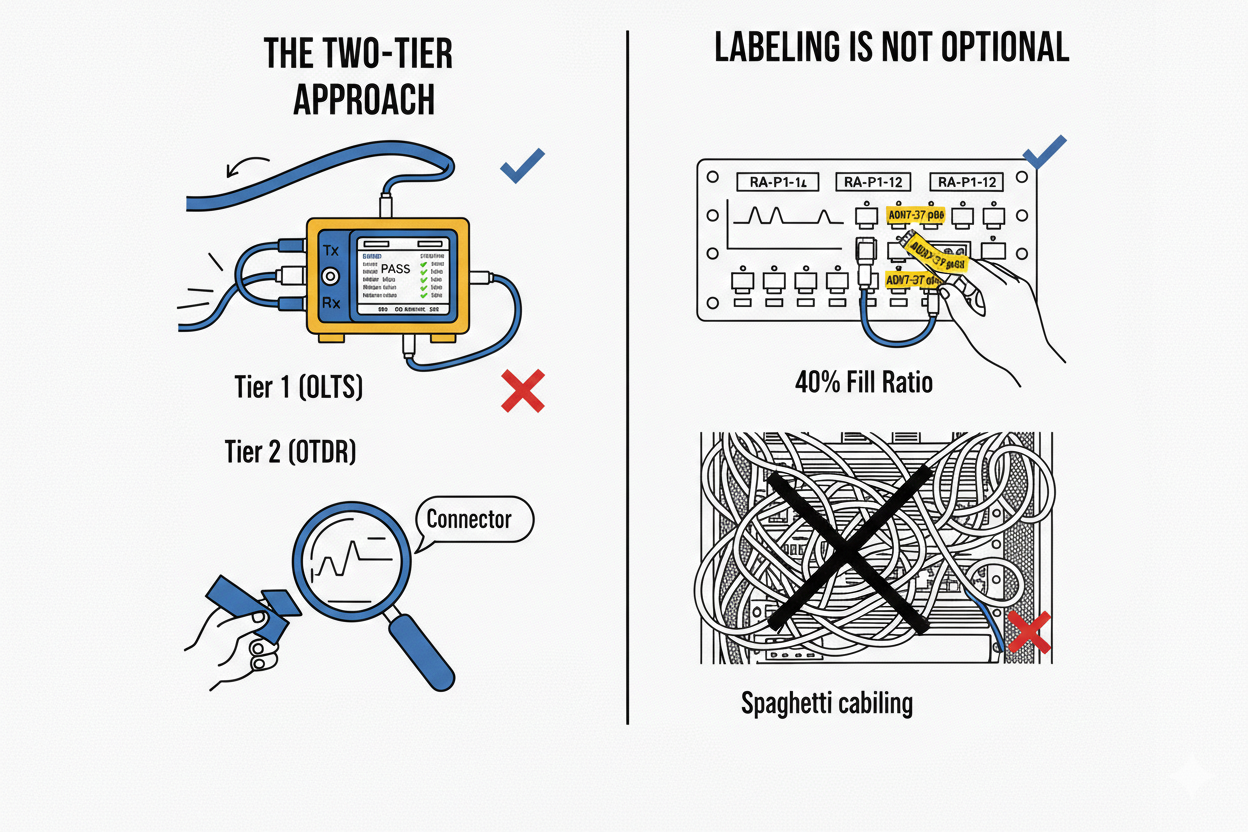
Conduit Capacity: Don't overfill conduits. Stick to the 40% fill ratio rule to ensure you can pull the cable safely without friction damage.
5. Testing and Documentation
You cannot see light moving through the cable; you must prove it is there.
The Two-Tier Testing Approach
Tier 1 (OLTS): An Optical Loss Test Set measures the total insertion loss (attenuation) and length. This is a "Pass/Fail" test against standards like TIA-568.
Tier 2 (OTDR): An Optical Time Domain Reflectometer creates a visual "trace" of the fibre run. It shows you exactly where splices, connectors, and bends are located and how much signal is lost at each specific point.
Labeling is Not Optional
"Spaghetti cabling" is the result of poor labeling. Label the cable on the jacket at both ends, and label the patch panel ports. Use a logical alphanumeric scheme (e.g., Rack A - Panel 1 - Port 12).
The Bottom Line
Fibre optic installation is as much an art as it is a science. It requires a delicate touch and a rigorous adherence to cleanliness. By respecting the bend radius, keeping connectors pristine, and documenting your work, you build a network infrastructure that is robust, scalable, and future-proof.
Do it right the first time, and the light will do the rest.
Feel free to use our Fibre Optic Pre-Installation Checklist
Fibre Is Only as Good as the Infrastructure Behind It
Even the best fibre installation won’t perform if the wider cabling system isn’t designed and installed correctly. Structured cabling provides the backbone that keeps your fibre network organised, scalable and performing at its peak.
If you’re investing in fibre, make sure the supporting infrastructure is built to the same standard.